, Arda Güler 1
, İbrahim Halil Tanboğa 2
, Mehmet Karacan 3
, İrem Türkmen 1
, Sezgin Atmaca 1
, Aysel Türkvatan Cansever 4
, Hasan Şahin 1
, Gizemnur Coşkun 1
, Sinem Aydın 4
, Dilara Pay 1
, Utku Yartası 1
, Nail Güven Serbest 1
, Muayad Almasri 1
, Mustafa Can Gündoğdu 1
, Duygu İnan 5
, Özgür Sürgit 1
, Mehmet Ertürk 1
, Arda Güler 1
, İbrahim Halil Tanboğa 2
, Mehmet Karacan 3
, İrem Türkmen 1
, Sezgin Atmaca 1
, Aysel Türkvatan Cansever 4
, Hasan Şahin 1
, Gizemnur Coşkun 1
, Sinem Aydın 4
, Dilara Pay 1
, Utku Yartası 1
, Nail Güven Serbest 1
, Muayad Almasri 1
, Mustafa Can Gündoğdu 1
, Duygu İnan 5
, Özgür Sürgit 1
, Mehmet Ertürk 1
2Department of Cardiology, Hisar Intercontinental Hospital, Nişantaşı University Medical School, Biostatistics, İstanbul, Türkiye
3Department of Pediatric Cardiology, University of Health Sciences, Ümraniye Training and Research Hospital, İstanbul, Türkiye
4Department of Radiology, University of Health Sciences, Mehmet Akif Ersoy Thoracic and Cardiovascular Surgery Center, Training and Research Hospital, İstanbul, Türkiye
5Department of Cardiology, University of Health Sciences, Başakşehir Çam Sakura City Hospital, İstanbul, Türkiye
Abstract
Background: Hypertrophic cardiomyopathy (HCM) is a complex myocardial disorder with heterogeneous clinical presentations and structural manifestations. This study aimed to assess the distribution, clinical characteristics, and diagnostic approaches in a regional cohort of patients with HCM.
Methods: Patients diagnosed with HCM at a tertiary cardiomyopathy clinic between October 2021 and November 2024 were retrospectively analyzed. Patients were classified into obstructive, latent obstructive, non-obstructive, or apical phenotypes based on clinical and imaging findings. Comprehensive demographic, clinical, and imaging data were collected for detailed analysis, providing valuable insights into the phenotypic diversity of HCM.
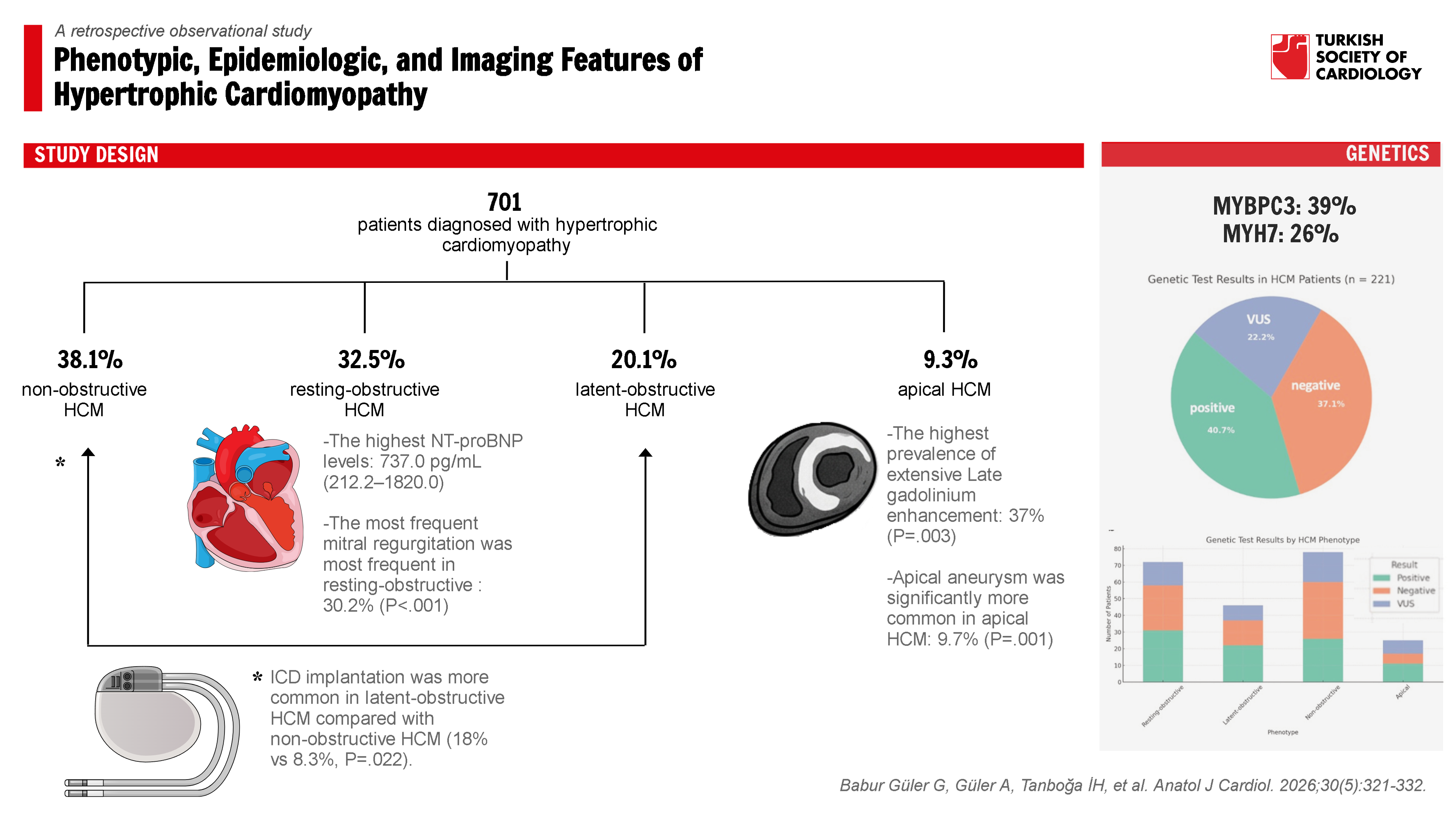
Results: The cohort included 701 patients with a median age of 53 years of whom 68% were male. The phenotypic distribution comprised 9.3% apical, 38.1% non-obstructive, 32.5% resting obstructive, and 20.1% latent obstructive HCM. Implantable cardioverter-defibrillator implantation was more common in obstructive phenotypes, particularly in the latent obstructive group. Although late gadolinium enhancement (LGE) was more frequently observed in apical HCM, post-hoc analysis showed no significant difference in prevalence across subgroups. In contrast, LGE extent was significantly greater in the apical group. Genetic testing, performed in 32% of patients, revealed a 44% positivity rate, with MYBPC3 and MYH7 being the most commonly detected mutations. The overall mortality rate was 2.8%, with heart failure identified as the leading cause of death.
Conclusion: In this large regional cohort of HCM patients, obstructive and non-obstructive phenotypes were predominant, with a notable burden of genetic mutations and a low overall mortality rate primarily driven by heart failure. These findings emphasize the clinical heterogeneity of HCM and highlight the importance of comprehensive diagnostic evaluation.
Graphical Abstract