


Abstract
Background: Transcatheter aortic valve implantation (TAVI) is an established alternative for patients with severe aortic stenosis who are unsuitable for surgical valve replace-ment. Conscious sedation is preferred to preserve spontaneous respiration and patient cooperation. Dexmedetomidine, a selective α2-adrenergic agonist, provides sedation, analgesia, and sympatholysis with minimal respiratory depression, making it suitable for high-risk TAVI patients.
Methods: We retrospectively analyzed 53 patients who underwent TAVI under dexme-detomidine-based sedation at a single center between January and July 2025. Patients received an initial loading dose of dexmedetomidine (1 μg/kg over 15 minutes) and fen-tanyl (1 μg/kg), followed by dexmedetomidine infusion (0.2-1.2 μg/kg/h) to achieve a Ramsay Sedation Score of 3-4 and bispectral index (BIS) 70-80. Hemodynamic param-eters were recorded at baseline (T0), post-loading (T1), 10 minutes post-loading (T2), and end of procedure (T3). Hemodynamic compromise was defined as a >30% decrease in systolic or mean arterial pressure(MAP) <65 mm Hg.
Results: The mean age was 76.4 ± 7.3 years, with 58.5% female; all patients were ASA III–IV. Mean arterial pressure (MAP) remained above 65 mm Hg at all time points, with the greatest decrease at T2. Systolic and MAP reductions were consistently below the 30%threshold. Postoperative complications included pacemaker implantation in 2 patients, transient contrast-induced nephropathy in 1, and temporary inotropic support in 4. No anesthesia-related respiratory complications occurred.
Conclusions: Dexmedetomidine combined with fentanyl provides safe and effective sedation for TAVI, maintaining hemodynamic stability and spontaneous respiration. This sedation protocol minimizes perioperative risks and may improve procedural safety in high-risk patients.
Graphical Abstract
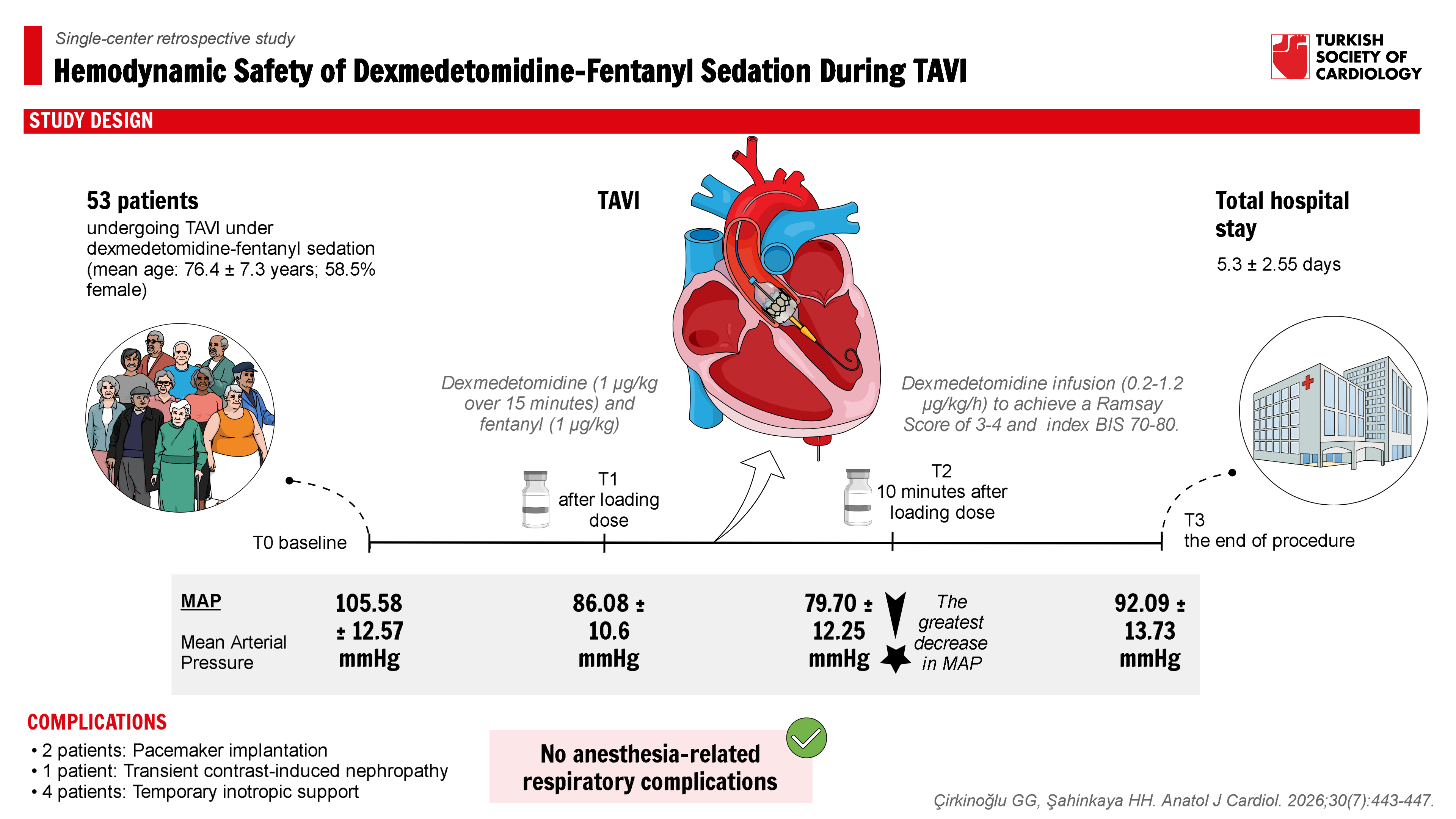
Highlights
- Dexmedetomidine-fentanyl sedation maintained stable hemodynamics during transcatheter aortic valve implantation (TAVI).
- No anesthesia-related respiratory complications were observed.
- Conversion to general anesthesia was not required in any patient.
- Postoperative complications were minimal and manageable.
- This sedation protocol may enhance safety in high-risk TAVI patients.
Introduction
Degenerative calcific aortic stenosis is the most frequent valvular heart disease in Western countries, with a prevalence of about 3% after the age of 75.
Conscious sedation during TAVI aims to prevent pain and discomfort while allowing patient communication.
Dexmedetomidine is a sedative agent with anxiolytic, hypnotic, analgesic, and sympatholytic properties, making it suitable for sedation during TAVI procedures.
It exerts its effects through α2-adrenergic receptors in the central, peripheral, and spinal cord, without affecting GABA receptors.
This retrospective study aimed to evaluate our institutional experience with dexmedetomidine-based sedation in patients undergoing TAVI.
Methods
This single-center retrospective study was conducted after obtaining approval from the Local Ethics Committee (decision no. 2025/412, dated 27/08/2025). The need for written informed consent was waived by the ethics committee due to the retrospective nature of the study using the electronic medical records and perioperative anesthesia documents. Data were recorded from the electronic medical records and perioperative anesthesia documents. Patients with missing data, those who received general anesthesia, patients whose anesthesia method was changed for any reason, and those who received sedation techniques other than the routine institutional protocol were excluded from the study.
In our routine protocol, patients undergoing TAVI routinely receive standard ASA monitoring, including invasive arterial pressure monitoring and bispectral index (BIS) monitoring. For sedation, an initial intravenous dose of fentanyl (1 μg/kg) and dexmedetomidine (1 μg/kg over 15 minutes) is administered, followed by a dexmedetomidine infusion at 0.2-1.2 μg/kg/min for maintenance of sedation. If bradycardia occurs during the procedure, the infusion rate is reduced or an alternative anesthetic agent is administered. The maintenance dose is titrated to achieve a Ramsay Sedation Score of 3-4 and a BIS value between 70 and 80.
Data Collection and Hemodynamic Assessment
Patient demographics, including age, sex, weight, American Society of Anesthesiologists (ASA) physical status classifications, comorbidities, ejection fraction, hospital length of stay, intensive care unit stay, and 1-week and 1-month mortality were recorded. From anesthesia monitoring forms, data on the type of anesthesia administered, drugs used, pre-procedural blood pressure, heart rate, and peripheral oxygen saturation were collected, as well as intra-procedural hemodynamic parameters following drug administration, complications related to anesthesia or the procedure.
Hemodynamic effects after drug administration were assessed by changes in systolic and mean arterial pressures (MAPs). A decrease of more than 30% from baseline in systolic or MAP, or a systolic arterial pressure below 90 mmHg or MAP below 65 mm Hg, was considered a hemodynamic compromise. Baseline hemodynamic data were recorded as T0, hemodynamic parameters after dexmedetomidine administration as T1, measurements 10 minutes after completion of drug administration as T2, and hemodynamic parameters at the end of the procedure as T3.
Statistical Analysis
Statistical analyses were performed using IBM SPSS Statistics Standard Concurrent User V30 (IBM Corp., Armonk, NY, USA). The normality of continuous variables was assessed using the Kolmogorov–Smirnov test. Continuous variables are presented as mean ± standard deviation (SD).
A 1-sample
Results
During the specified study period, data from 68 patients were collected. Of these, 4 patients received general anesthesia, 2 patients developed cardiac arrest due to mechanical complications following valve opening and were switched to general anesthesia, and 2 patients could not receive dexmedetomidine due to bradycardia. Additionally, 5 patients were excluded due to incomplete data. Consequently, data from 53 patients who received sedation and analgesia with dexmedetomidine were analyzed (
The mean systolic arterial pressure of the patients was highest at T0 and lowest at T2 (T0: 150 [25], T1: 110 [18], T2: 100 [15], and T3: 130 [26]). At all time points, the MAP remained above 65 mm Hg. The hemodynamic parameters and sedation scores of the patients are summarized in
The mean MAP after drug administration was 86.08 ± 10.6 mm Hg at T1 (difference: +21.07; 95% CI: 18.15-24.00; t(52) = 14.436;
The decrease in MAP after drug administration was significantly lower than the 30% reference value at all time points (
The decrease in systolic arterial pressure after drug administration varied according to time points when compared with the 30% decrease reference value (
The mean intensive care unit (ICU) stay of the patients was 1.94 ± 1.72 days, and the total hospital stay was 5.3 ± 2.55 days. Postoperatively, 2 patients required pacemaker implantation due to heart block, 1 patient developed transient contrast-induced nephropathy, and 4 patients received temporary inotropic support. No patient required inotropic support prior to valve opening. No anesthesia-related complications were observed.
Discussion
Dexmedetomidine is a highly selective α2-adrenergic receptor agonist that has gained widespread use in sedative procedures due to its unique pharmacological profile. Unlike traditional sedatives such as propofol or benzodiazepines, dexmedetomidine provides sedation while preserving respiratory drive, allowing patients to remain arousable and cooperative during procedures. Its anxiolytic, hypnotic, and sympatholytic properties make it particularly valuable in procedures where patient cooperation and spontaneous respiration are essential, including dental sedations, endoscopic interventions, fiberoptic interventions, minor surgical procedures, and cardiac catheterizations.
In recent years, dexmedetomidine has also been increasingly investigated as a sedative agent in patients undergoing TAVI. Compared to agents such as propofol, midazolam, and remifentanil, dexmedetomidine has been associated with more stable hemodynamic parameters and lower rates of respiratory depression, which are critical considerations in this high-risk population.
In the context of TAVI, especially in elderly patients with severe aortic stenosis and multiple comorbidities, sedation management poses significant challenges. Hemodynamic instability, respiratory depression, and procedural complications are major concerns. Our study demonstrates that a combination of dexmedetomidine and fentanyl provides effective sedation while maintaining MAP above clinically significant thresholds and avoiding significant drops in systolic blood pressure. Importantly, no anesthesia-related respiratory complications occurred, highlighting the safety of this regimen in a vulnerable patient population.
These findings align with previous reports suggesting that dexmedetomidine offers superior hemodynamic and respiratory safety compared to traditional sedatives. The absence of severe perioperative complications, along with stable hemodynamics and preserved patient cooperation, underscores the clinical relevance of this sedation strategy.
Clinically, this study provides practical evidence that dexmedetomidine-fentanyl sedation can be safely implemented in routine TAVI procedures in patients at high perioperative risk. This approach may contribute to reduced hemodynamic stress and improved overall procedural safety. Our results may guide anesthesiologists in optimizing sedation protocols for elderly, high-risk TAVI patients, reinforcing the importance of individualized, hemodynamically stable sedation strategies in structural heart interventions.
Study Limitations
This study is retrospective and single-center, with a modest sample size. Future prospective, multicenter studies are warranted to confirm these findings and to further assess the impact of dexmedetomidine-fentanyl sedation on clinical outcomes such as long-term cardiovascular events and hospital resource utilization.
Conclusion
In conclusion, dexmedetomidine combined with fentanyl provides safe and effective sedation for TAVI, maintaining hemodynamic stability and spontaneous respiration. This regimen minimizes perioperative risk, improves procedural safety in high-risk patients, and represents a clinically relevant alternative to general anesthesia.
Footnotes
This manuscript was prepared with the assistance of an artificial intelligence language model (ChatGPT, OpenAI) for language editing and text refinement. The authors reviewed, edited, and approved the final version of the manuscript and take full responsibility for its content.
References
- Iung B, Vahanian A. Degenerative calcific aortic stenosis: a natural history. Heart. 2012;98(suppl 4):iv7-i13.
- Patel JH, Mathew ST, Hennebry TA. Transcatheter aortic valve replacement: a potential option for the nonsurgical patient. Clin Cardiol. 2009;32(6):296-301.
- Bianchi M, Marom G, Ghosh RP. Effect of balloon-expandable transcatheter aortic valve replacement positioning: a patient-specific numerical model. Artif Organs. 2016;40(12):E292-E304.
- Rex S. Anesthesia for transcatheter aortic valve implantation: an update. Curr Opin Anaesthesiol. 2013;26(4):456-466.
- Mayr NP, Michel J, Bleiziffer S, Tassani P, Martin K. Sedation or general anesthesia for transcatheter aortic valve implantation (TAVI). J Thorac Dis. 2015;7(9):1518-1526.
- Cristiano L, Coppolino F, Donatiello V. Use of dexmedetomidine in transfemoral transcatheter aortic valve implantation (tf-TAVI) procedures. Adv Ther. 2020;37(5):2337-2343.
- Liao W, Li S, Chen Q. Dexmedetomidine for cancer pain: mechanisms and opioid-sparing effects. Int J Surg. 2025;111(7):4694-4703.
- Chen ZR, Hong Y, Wen SH, Zhan YQ, Huang WQ. Dexmedetomidine pretreatment protects against myocardial ischemia/reperfusion injury by activating STAT3 signaling. Anesth Analg. 2023;137(2):426-439.
- Barot G, Patel M, Patel C, Fernandes MC, Patel F, Mehta M. Comparative effectiveness and safety of dexmedetomidine and midazolam in pediatric dental sedation: a systematic review and meta-analysis. J Dent Anesth Pain Med. 2025;25(3):147-159.
- Sivakumar R, Ramachandran R, Trikha A, Kumar S, Laxmi B, Rewari V. Dexmedetomidine vs. midazolam-ketamine for sedation during awake fiberoptic nasal intubation in patients with difficult airway – A randomized, double-blinded, comparative trial. J Anaesthesiol Clin Pharmacol. 2025;41(3):496-502.
- Ishido K, Tanabe S, Kitahara G. Feasibility of non-anesthesiologist-administered sedation with dexmedetomidine and midazolam during endoscopic submucosal dissection of upper gastrointestinal tumors. DEN Open. 2024;5(1):-.
- Douglas MS, Soloniuk LJ, Jones J, Derderian R, Baker C, Stier G. Intravenous dexmedetomidine use in obstetric anesthesia: a focused review. Int J Obstet Anesth. 2025;62():-.
- Mayr NP, Wiesner G, van der Starre P. Dexmedetomidine versus propofol-opioid for sedation in transcatheter aortic valve implantation patients: a retrospective analysis of periprocedural gas exchange and hemodynamic support. Can J Anaesth. 2018;65(6):647-657.
- Luzzi C, Orlov D, Foley K. Choice of anesthesia technique is associated with earlier hospital discharge and reduced costs after transcatheter transfemoral aortic valve implantation. J Thorac Dis. 2024;16(3):1836-1842.
- Chowdhury S, Sawires J, Weissman B, Saju S, Lambroussis CG. Comparing the efficacy and safety of dexmedetomidine versus propofol for sedation in adult patients undergoing cardiac procedures: a systematic review. Cureus. 2025;17(9):e91773-.
- Song Y, Zhang J, Xu H. Assessment of the impact of dexmedetomidine on myocardial injury in TAVI patients: a retrospective cohort study utilizing PSM-DID. Ther Clin Risk Manag. 2025;21():583-592.