

 , Önder Bilge 2
, Ferhat Işık 2
, Abdurrahman Akyüz 2
, Emre Kıvrak 1
, Esra Yılmaz 1
, İlke Çelikkale 1
, Özcan Özdemir 3
, İbrahim Halil Tanboğa 4
, Önder Bilge 2
, Ferhat Işık 2
, Abdurrahman Akyüz 2
, Emre Kıvrak 1
, Esra Yılmaz 1
, İlke Çelikkale 1
, Özcan Özdemir 3
, İbrahim Halil Tanboğa 4
2Department of Cardiology, University of Health Sciences Diyarbakır Gazi Yaşargil Education and Research Hospital, Diyarbakır, Türkiye
3Department of Cardiology, Etlik City Hospital, Ankara, Türkiye
4Department of Cardiology, University of Nişantaşı, İstanbul, Türkiye
Abstract
Background: The optimal treatment strategy for isolated side branch (SB) lesions remains uncertain. In this study, the aim was to evaluate the safety and efficacy of drug-coated balloon (DCB) angioplasty for the treatment of de novo isolated SB stenosis.
Methods: This single-center, retrospective study included patients with symptomatic isolated SB occlusion who underwent percutaneous coronary intervention using DCB. The primary endpoint was procedural success, and the secondary endpoint was the occurrence of major adverse cardiac events, defined as death from all causes, myocardial infarction, target vessel revascularization, or revascularization of target lesions.
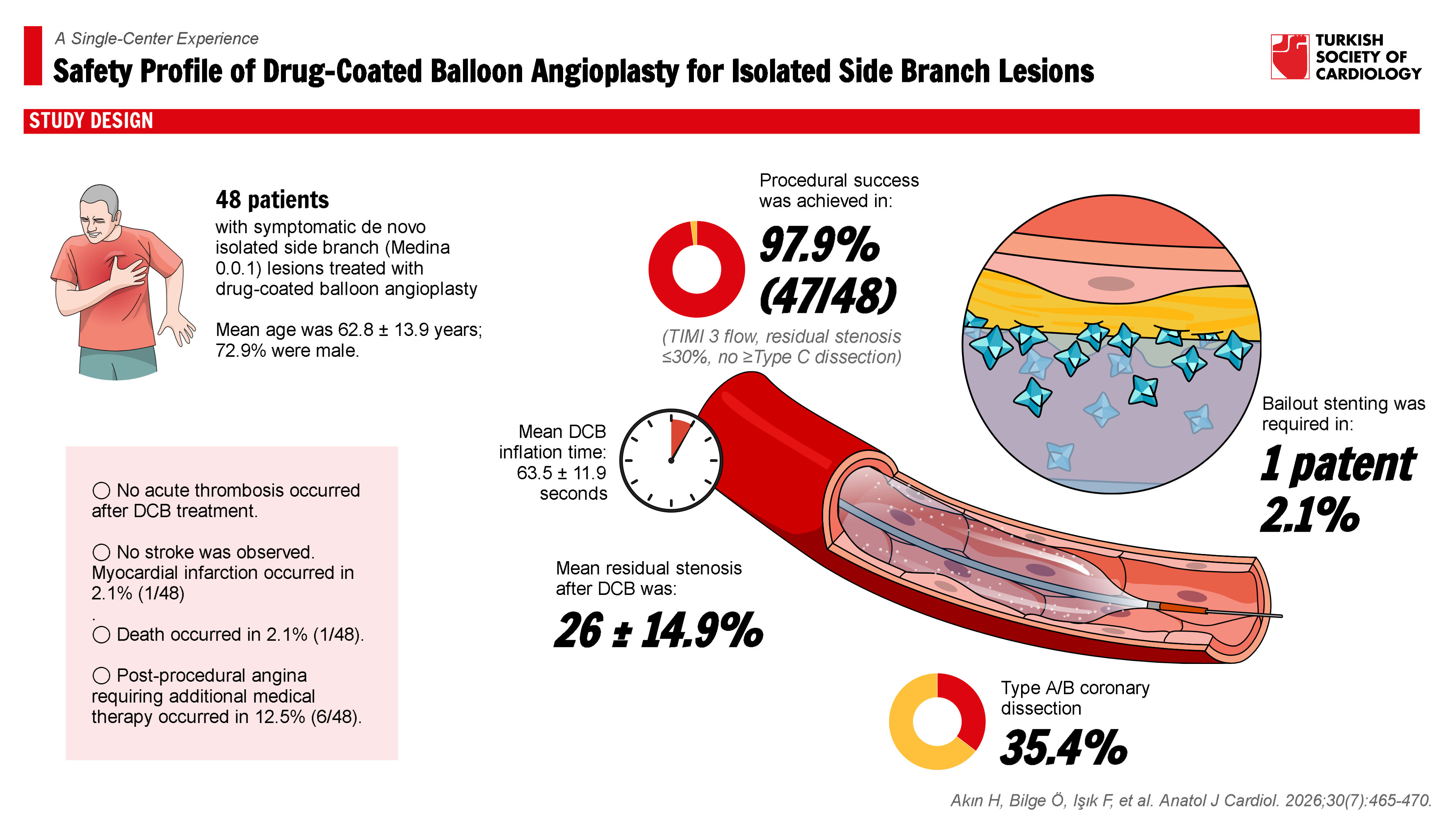
Results: Forty-eight patients were included between April 2022 and June 2025. The mean age was 62.8 ± 13.9 years, and the majority were male (n = 35, 72.9%). The cohort exhibited a high cardiovascular risk profile. Procedural success was achieved in 97.9% (n = 47). Thrombolysis in myocardial infarction grade 3 flow was obtained in all patients, with a mean residual stenosis of 26% ± 14.9. One patient (2.1%) required bailout stenting, and no cases of acute thrombosis were observed. During a mean follow-up of 423 days, 8 patients (16.7%) underwent repeat coronary angiography for angina, 6 patients (12.5%) required additional medical therapy, and 1 patient (2.1%) experienced myocardial infarction.
Conclusion: These findings suggest that, with appropriate lesion preparation and patient selection, DCB angioplasty represents a safe and feasible revascularization strategy for isolated SB occlusions. However, larger, controlled, and long-term studies are needed to confirm these results.
Graphical Abstract
Highlights
- The success of drug-coated balloon (DCB) treatment of isolated side branch (SB) occlusions depends on appropriate lesion preparation.
- Drug-coated balloon treatment of isolated SB occlusions offers the advantages of shorter procedure times, less radiation exposure, and less contrast material use.
- No risk of acute thrombosis has been identified with DCB application in isolated SB occlusions.
- Drug-coated balloon treatment is a promising treatment strategy for patients with Medina 0.0.1 lesions who experience chest pain despite medical treatment.
Introduction
Isolated side branch (SB) stenosis in coronary artery disease represents one of the most challenging lesion subsets in interventional cardiology. Compared with non-bifurcation lesions, these lesions are associated with a higher risk of ischemic events. The small vessel diameter, close anatomical relation with the main vessel, and difficulty in maintaining main vessel flow during the procedure make treatment decisions complex. As these lesions constitute less than 5% of all bifurcation lesions, the rarity and unique characteristics of Medina 0.0.1 bifurcation lesions result in limited evidence regarding optimal treatment strategies and necessitate an individualized approach.
In recent years, drug-coated balloon (DCB) technology has emerged as an innovative stentless option that provides homogeneous local drug delivery, accelerates vessel healing, reduces neointimal proliferation, and preserves physiological vasomotion.
Methods
Study Design and Participants
Between April 2022 and June 2025, all patients who underwent coronary angiography for stable angina, unstable angina, or acute coronary syndrome were screened. Patients with isolated SB
Definitions
Procedure
For isolated SB lesions identified as the culprit, predilation was performed with semi-compliant or non-compliant balloons. After adequate lesion preparation, DCB angioplasty was performed if the following angiographic criteria were met: TIMI flow grade 3, residual stenosis ≤30%, and absence of dissection ≥type C. A DCB matched 1 : 1 to the vessel diameter was inflated at nominal pressure for at least 60 seconds. In patients who experienced chest discomfort during DCB inflation, the balloon was deflated for 15 seconds and then reinflated twice for 30 seconds each. All DCB procedures were performed using SeQuent Please NEO (B. Braun Medical, Melsungen, Germany).
Statistical Analysis
Descriptive statistics for continuous variables are expressed as mean ± SD or median (interquartile range). Categorical variables are presented as counts (n) and percentages (%), and 95% CIs were calculated using the Wilson method. The primary safety endpoints were periprocedural complications which consisted of dissection, bailout stenting, acute thrombosis, and periprocedural myocardial infarction. Owing to the small sample size and multiple comparisons, the analysis was considered hypothesis generating. All analyses were performed using Python 3.11 (pandas, statsmodels).
Results
A total of 48 patients with isolated SB occlusion (Medina 0.0.1) treated only with DCB were included in this study. The baseline demographic and clinical characteristics are detailed in
The primary clinical presentation for the index procedure was unstable or stable angina pectoris in 87.5% (n = 42) of cases, while the remaining 12.5% (n = 6) presented with an acute coronary syndrome. The most frequently treated vessel was the left anterior descending artery/diagonal branches (n = 23, 47.9%), followed by the left circumflex artery (LCx) (n = 13, 27.1%) and obtuse marginal branches (n = 10, 20.8%). Angiographic analysis demonstrated a high degree of lesion severity. The mean baseline stenosis of the treated vessel was greater than 90%, with 47.9% exhibiting stenosis of 95% or greater. All patients underwent lesion preparation with predilation prior to DCB application. Non-compliant balloons were used for predilation in 60.4% (n = 29) of cases, while semi-compliant balloons were used in 39.6% (n = 19). The mean diameter of the primary predilation balloon was 2.28 ± 0.51 mm. The average number of DCBs used per patient was 1.1 ± 0.4. The mean diameter and length of the primary DCB were 2.54 ± 0.47 mm and 23.9 ± 7.5 mm, respectively. The DCB was inflated to a mean pressure of 8 atm for an average duration of 63.5 ± 11.9 seconds. The procedural and angiographic outcomes were highly successful. As documented in the provided literature, achieving optimal lesion preparation is paramount for DCB success. In this cohort, post-procedural TIMI flow was grade 3 in all 48 patients. The mean residual stenosis after the DCB procedure was 26% ± 14.9, meeting the generally accepted criterion of <30% for a successful angiographic result (
Procedural Complications and Clinical Outcomes
The overall procedural success rate was 97.9% (n = 47) (
Discussion
In this study, DCB angioplasty was found to be a safe and feasible therapeutic option for one of the most technically demanding lesion types in interventional cardiology, specifically isolated SB occlusion (Medina 0.0.1), treated without stent implantation.
As Medina 0.0.1 lesions account for only 3%-5% of all bifurcations, clinical evidence remains scarce, and an individualized approach is needed. Compared with other bifurcation patterns, isolated SB lesions present several technical difficulties: the risk of main vessel injury during SB intervention, a fibrocalcific plaque structure with high recoil potential and limited acute gain,
In previous studies evaluating Medina 0.0.1 lesions treated with either stent implantation or medical therapy, MACE rates were found to be high. A recent meta-analysis comparing 1-stent and 2-stent strategies in Medina 0.0.1 lesions found similar rates of MACE between the 2 techniques.
Certain complications may occur in patients undergoing DCB treatment. Regarding type A-B coronary dissections, the incidence in this study (35.4%) was comparable to that reported by Gitto et al
In cases of flow-limiting dissection, treatment with bailout stenting may be necessary. In this cohort, the bailout stent rate was 2%, which is lower than that reported in the DCB-BIF (~4%) and PEPCAD-BIF (7.8%) trials.
When these results—in the absence of acute thrombosis, 97.9% procedural success, and low adverse event rates—are considered alongside these data, DCB angioplasty appears to be a safe and feasible approach for Medina 0.0.1 lesions. The present findings align with those of Erdoğan et al24, who treated major branches of the left main trunk with ostial DCB. Furthermore, this study obtained similar results to the PICCOLETO II – Side Branch Sub-Study, BASKET-SMALL 2 Sub-Analysis, DEBSIDE Study, and PEPCAD-BIF Trial, all of which evaluated DCB treatment outcomes in isolated SB occlusions.
Study Limitations
This study has several limitations. This study is designed as a hypothesis-generating retrospective observational cohort evaluating procedural safety and feasibility rather than a comparative efficacy trial. It is a retrospective, single-center study with a limited number of patients and no control group. The absence of intravascular imaging (Intravascular Ultrasound-OCT) and pre/post-procedure physiological evaluation (fractional flow reserve) is another limitation. Furthermore, direct comparison of angiographic outcomes was not possible because routine follow-up angiography was not performed. Despite these constraints, the available follow-up data provide meaningful insight into the safety and feasibility of DCB angioplasty in this specific lesion subset.
Conclusion
This single-center, retrospective study with a small sample size demonstrates that DCB angioplasty can be performed safely and feasibly in isolated SB lesions, with low complication rates. Bailout stenting and periprocedural MI were uncommon, and most dissections were minor. Proper lesion preparation and patient selection are key to procedural success. Larger, prospective studies with longer follow-up are needed to validate these results.
Footnotes
The authors declare that they did not use artificial intelligence (AI)-supported technologies (such as Large Language Models [LLM], chatbots, or visual generators) in the production of the work.
References
- Lassen JF, Holm NR, Banning A. Percutaneous coronary intervention for bifurcation disease: 15th consensus document from the European Bifurcation Club. EuroIntervention. 2021;17(2):e230-e248.
- Burzotta F, Lassen JF, Lefèvre T. Percutaneous coronary intervention for bifurcation lesions: current concepts and technical aspects. Circ Cardiovasc Interv. 2020;13(2):-.
- Kleber FX, Rittger H, Bonaventura K. Drug-coated balloons for coronary artery disease: updated recommendations from the German Consensus Group. Clin Res Cardiol. 2023;112(2):119-130.
- Scheller B, Speck U, Abramjuk C, Bernhardt U, Böhm M, Nickenig G. Paclitaxel balloon coating: a novel method for prevention and therapy of restenosis. Circulation. 2004;110(7):810-814.
- Corballis NH, Paddock S, Gunawardena T, Merinopoulos I, Vassiliou VS, Eccleshall SC. Drug coated balloons for coronary artery bifurcation lesions: a systematic review and focused meta-analysis. PLoS One. 2021;16(7):-.
- Özbay MB, Değirmen S, Güllü A, Nriagu BN, Özen Y, Yayla Ç. Drug-Coated Balloons vs. plain Balloon angioplasty for Side Branch Management in Coronary Bifurcation Lesions: a Systematic Review and Meta-Analysis. Anatol J Cardiol. 2025;29(6):272-279.
- Serruys PW, Tobe A, Ninomiya K. Does the axiom of “the more you gain, the more you lose” in balloon angioplasty still hold true in the era of DCB with paclitaxel?. Cardiovasc Revasc Med. 2024;69():70-78.
- Fezzi S, Giacoppo D, Fahrni G. Individual patient data meta-analysis of paclitaxel-coated balloons vs. drug-eluting stents for small-vessel coronary artery disease: the ANDROMEDA study. Eur Heart J. 2025;46(17):1586-1599.
- Jeger RV, Farah A, Ohlow MA. Long-term efficacy and safety of drug-coated balloons versus drug-eluting stents for small coronary artery disease (BASKET-SMALL 2): 3-year follow-up of a randomised, non-inferiority trial. Lancet. 2020;396(10261):1504-1510.
- Cortese B, Di Palma G, Guimaraes MG. Drug-eluting stent versus drug-coated balloon for small coronary vessel disease: the PICCOLETO II randomized clinical trial. JACC Cardiovasc Interv. 2020;13(24):2840-2849.
- Tang Y, Qiao S, Su X. RESTORE SVD China investigators. Drug-eluting balloon versus drug-eluting stent for small vessel disease: the RESTORE SVD China randomized trial. JACC Cardiovasc Interv. 2018;11(23):2381-2392.
- Suleiman S, Coughlan JJ, Touma G, Szirt R. Contemporary management of isolated ostial side branch disease: an evidence-based approach to Medina 001 bifurcations. Interv Cardiol. 2021;16():-.
- Togni M, Eber S, Widmer J. Effect of vessel size on outcome after implantation of sirolimus-eluting and paclitaxel-eluting stents: subgroup analysis of the SIRTAX trial. J Am Coll Cardiol. 2007;50(12):1123-1131.
- Mohamed MO, Lamellas P, Roguin A. Clinical outcomes of percutaneous coronary intervention for bifurcation lesions according to Medina classification. J Am Heart Assoc. 2022;11(17):-.
- Choi KH, Bruno F, Cho YK. Comparison of outcomes between 1- and 2-stent techniques for Medina classification 0.0.1 coronary bifurcation lesions. JACC Cardiovasc Interv. 2023;16(17):2083-2093.
- Brueck M, Heidt M, Kramer W, Ludwig J. Comparison of interventional versus conservative treatment of isolated ostial lesions of coronary diagonal branch arteries. Am J Cardiol. 2004;93(9):1162-1164.
- Gitto M, Leone PP, Gioia F. Coronary artery dissection in drug-coated balloon angioplasty: incidence, predictors, and clinical outcomes. Am J Cardiol. 2025;239():28-35.
- Pan L, Lu WJ, Han ZY. Drug-coated balloons for the treatment of ostial left anterior descending or ostial left circumflex artery lesions: a patient-level propensity score-matched analysis. J Geriatr Cardiol. 2023;20(10):716-727.
- El Khoury A, Lazar L, Cortese B. The fate of coronary dissections left after sirolimus-coated balloon angioplasty: a prespecified subanalysis of the Eastbourne study. Catheter Cardiovasc Interv. 2023;102(6):979-986.
- Gao X, Tian N, Kan J. Drug-coated balloon angioplasty of the side branch during provisional stenting: the multicenter randomized DCB-BIF trial. J Am Coll Cardiol. 2025;85(1):1-15.
- Kleber FX, Rittger H, Ludwig J. Drug eluting balloons as stand alone procedure for coronary bifurcational lesions: results of the randomized multicenter PEPCAD-BIF trial. Clin Res Cardiol. 2016;105(7):613-621.
- Pellegrini D, Donahue M, Regazzoli D. Drug-coated balloon combined with drug-eluting stent for the treatment of coronary bifurcation lesions: insights from the HYPER study. Eur Heart J Suppl. 2023;25(suppl C):C79-C83.
- Vaquerizo B, Fernández-Nofreiras E, Oategui I. Second-generation drug-eluting balloon for ostial side branch lesions (001-bifurcations): mid-term clinical and angiographic results. J Interv Cardiol. 2016;29(3):285-292.
- Erdoğan E, Li Z, Zhu YX. DCB combined with provisional DES implantation in the treatment of de Novo Medina 0,1,0 or 0,0,1 left main coronary bifurcation lesions: a proof-of-concept study. Anatol J Cardiol. 2022;26(3):218-225.
- Cortese B, Testa G, Rivero F, Erriquez A, Alfonso F. Long-term outcome of drug-coated balloon vs drug-eluting stent for small coronary vessels: PICCOLETO-II 3-year follow-up. JACC Cardiovasc Interv. 2023;16(9):1054-1061.
- Berland J, Lefèvre T, Brenot P. Danubio - a new drug-eluting balloon for the treatment of side branches in bifurcation lesions: six-month angiographic follow-up results of the DEBSIDE trial. EuroIntervention. 2015;11(8):868-876.